
Why AI Is Dangerous For Business (but not the way you think)

In this short article, I attempt to tackle the use of Artificial Intelligence as an ideation tool, why it's a stupid thing to do - and how to recognize when you're doing it.
With the power of LLMs - average was never so easy to create
Why I'm writing this
Over the past few years we've witnessed the integration of AI into a whole lot of existing workflows across industries. Things that previously required people to apply focus & intention to - like code writing - can now be delegated to these fancy algorithms. Summarizing meetings has now become a relic of the past; Why would anyone sit down and synthesize existing information when they have the option not to?
Unfortunately, delegation can sometimes mean we forget to apply our own intelligence. LinkedIn posts (and quarterly reports) with little to no insights and buzz-filled articles with uninspired takes - have become abundant. Instead of crisp opinions, we are faced with fuzzy word salads that - while easy to generate - add zero net-new value to the world.
Judgement is a necessity to form opinions, ideate about business requirements and prioritize work; It is, however, very tempting to offload it to someone else.
Even with the introduction of advanced AI - distinguishing between "this is an output" and "this is the truth" has largely remained a human burden; Yet, this fact was somehow forgotten as models got better.
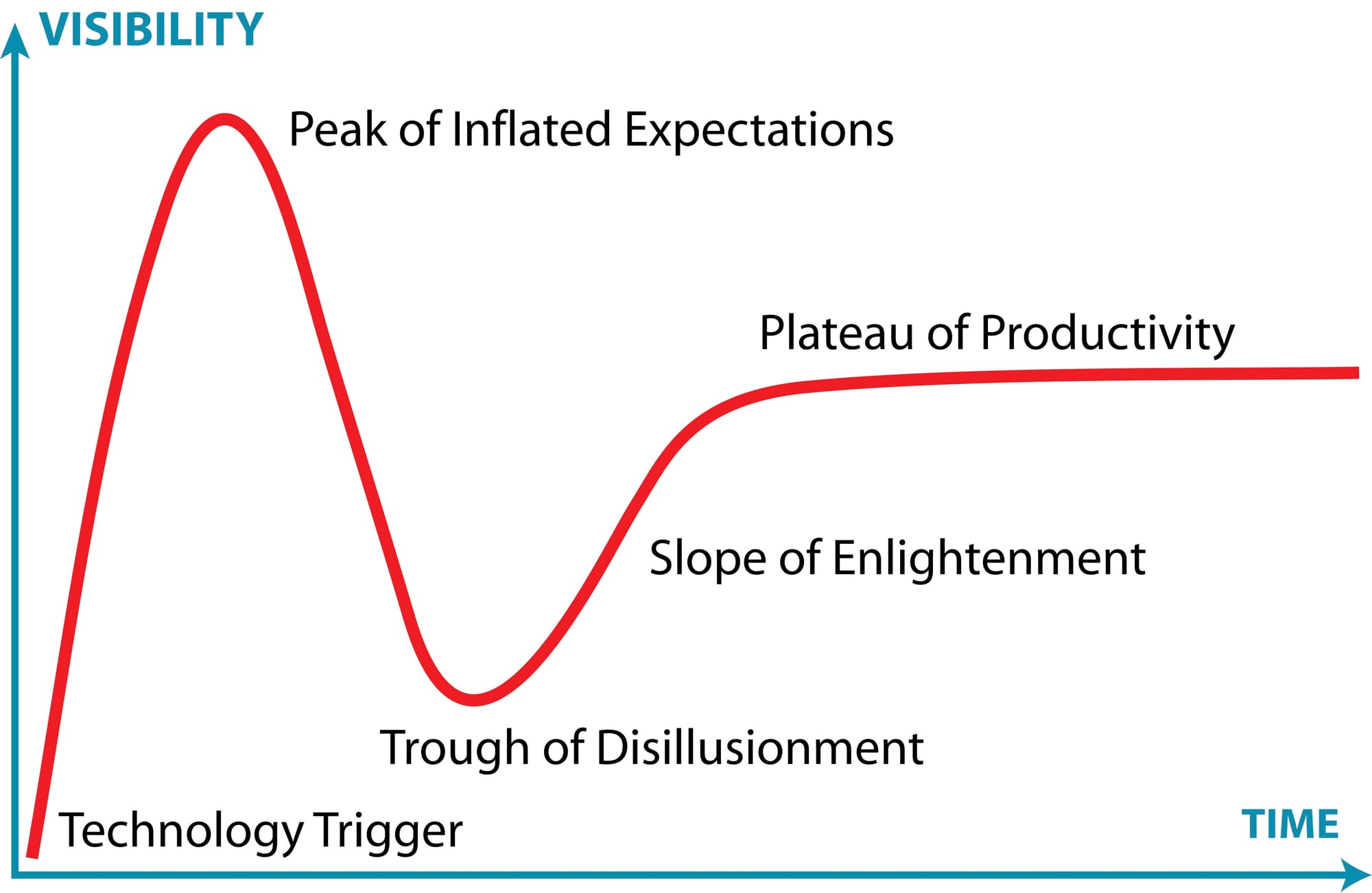
As the Gartner Hype-Cycle suggests, our ability to determine the limits of technology gets better over time; But until it does: we tend to hold the belief that it's going to solve fucking EVERYTHING.
I too, use AI
Before we dive into some human behavior, I should mention that I use AI daily - both as part of my job and just to screw around during my free time. LLMs, or as their fancier wrapping is branded - "AI" - are extremely useful tools; AI is especially good at searching, summarizing and tackling low-ambiguity, small-ish, tasks.
With AI, the distance between analyzing data or authoring a bug fix has changed from a multi-day adventure to a 20 minute thing. I am constantly blown away by how much I can delegate to it.
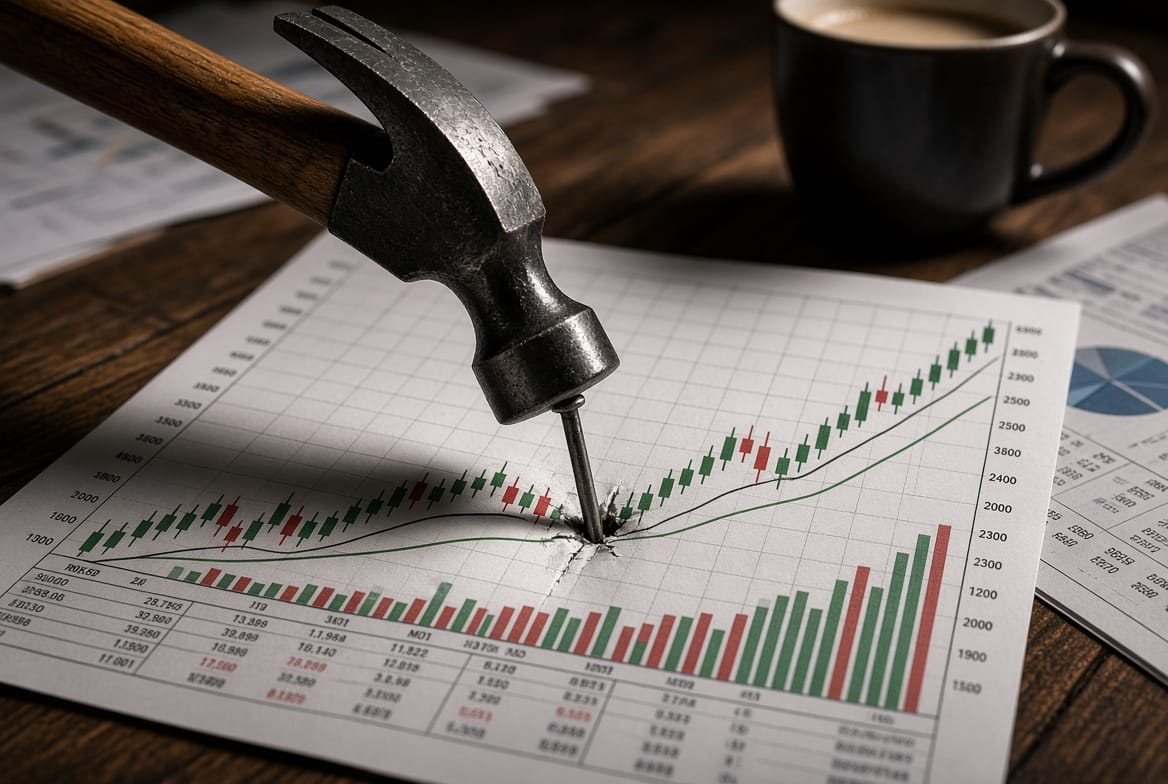
Everything looks like a nail when you hold a hammer
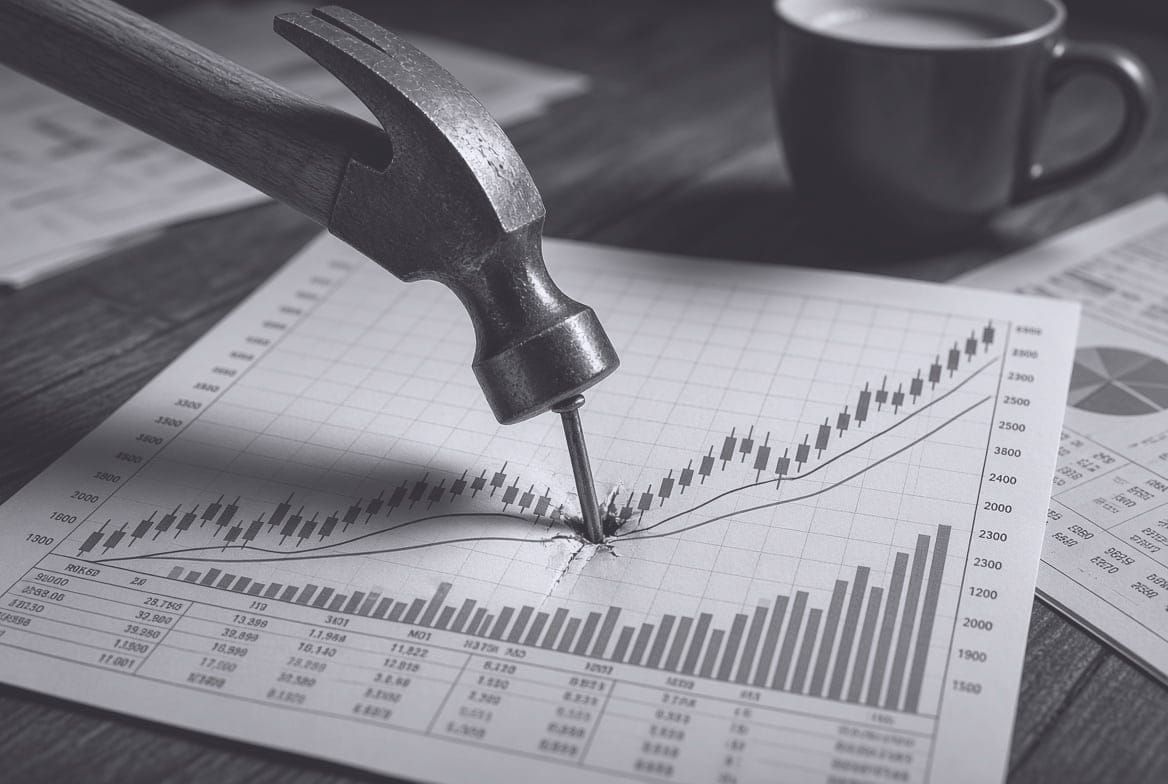
The famous MIT research around the decrease in brain activity with the use of LLMs - doesn't prove humans will necessarily get stupid with AI - but it clearly shows we can think less when using it. Thinking less can be awesome for undifferentiated tasks we find unenjoyable, like sifting through piles of Excel sheets or creating an image of a hammer nailing a stock chart.
As luck would have it, we are also a lazy bunch that dislikes spending energy on thinking. That's an old feature - not a bug. Our brains are evolutionarily wired to conserve energy as food is scarce in nature, and decision-making is something we actively avoid.
I am not a neuroscientist, but what I have observed over my career is that given the chance, and now, the technology - humans will prefer to avoid thinking hard.
The Averageness Trap
You know that feeling when something you read "reeks" of AI. I am not talking about em-dashes, but text that combines low & high level detail, repeating ideas and just generally - truly average everything.
LLMs at their core are reminisce of a compression algorithm. Take the internet and all existing human knowledge, smoosh them into a big matrix of weighted word connections - and TADA! you sorta have Claude.
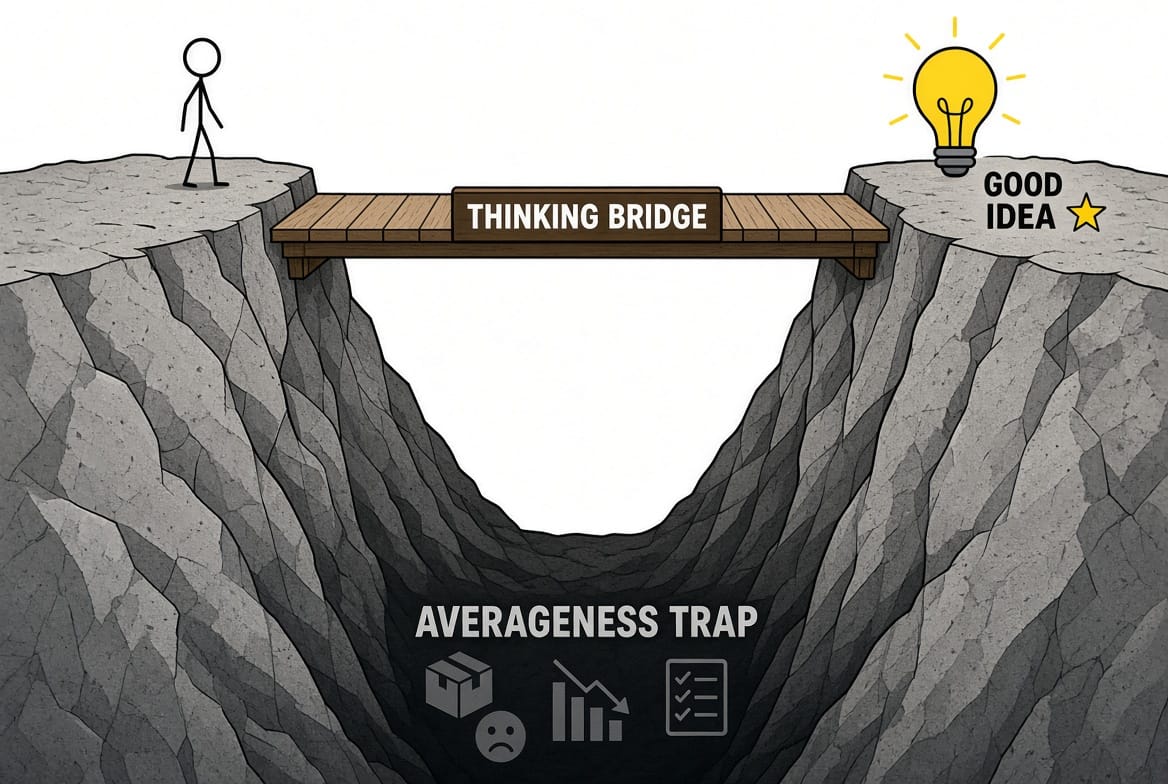
What I personally translate that to is the following: Artificial Intelligence as we know it today is excellent at non-exceptional things. It is very much capable of surfacing information and providing repetition of past work. It is not a tool that can replace decision making (yet).
As established above, we as humans prefer to avoid decision making and thinking hard. Our good ideas require us to spend time & energy - something we are actively trying to avoid. Combine that with the power of LLMs - average was never so easy to generate.
How to recognize the Averageness Trap
Realizing when we let LLMs drive us is not an easy ask. We still need to do our jobs and delegate where possible to remain productive in the age where answers are at our fingertips.
That said and with the understanding that this isn't an exact science, I give you my humble list of things to avoid:
- You are asking a calculator to give you ideas: If your prompts start to look more like "What do you think we should do?", "What do you recommend out of all these options?" and "Based on the data on X, should we make decision Y?" - you are asking AI to provide opinions.
For high-ambiguity decisions, clearly define what you are trying to solve before you go for AI-assistance. You can use AI to give you data - but not to decide for you. - You do not apply enough scrutiny to AI output: If you find reading gets you into a passive/agreeing state, you might be delegating decision-making without realizing it. A good exercise is to try and rewrite (I know, it sounds slow) the output in your own words. Otherwise - If you use AI output without understanding it - you might be the one being prompted.
- You are using too many words to say something: Creating text is really easy and with AI; we can create detailed reports within seconds. Walls of text too. If your work looks like a small novel, you are probably falling into another AI trap mentioned above - which is mixing high & low level detail. Humans find it difficult to concentrate for long periods of time - and your 100KB Slack message can be really hard to consume. You can actually use AI to solve this AI problem by asking for it to be more concise OR (and I recommend it) - try to rewrite the output yourself in your own words. You will be surprised how much slop you find.
Final thoughts
As I write this, I realize some folks will assume that the next model will have all the capabilities to handle tasks with even higher ambiguity. While that can happen, to me - that only means that we will have to make even better decisions.
Until the time our prompts will look like:
Make me a billion dollar e-commerce website, don't make any mistakes.
I think we'll need to use our human brains to make judgement calls.
I've been working in tech for over a decade. All the above is my own opinion, feel free to ignore it if you think AI will solve all your problems. AI was used to search and image-generate, but not to write any portion of this article.